
Sourcing & Trade Guide
5 Questions to Ask Before Choosing a Wholesale Supplier
Comilmart Team
August 20, 2026
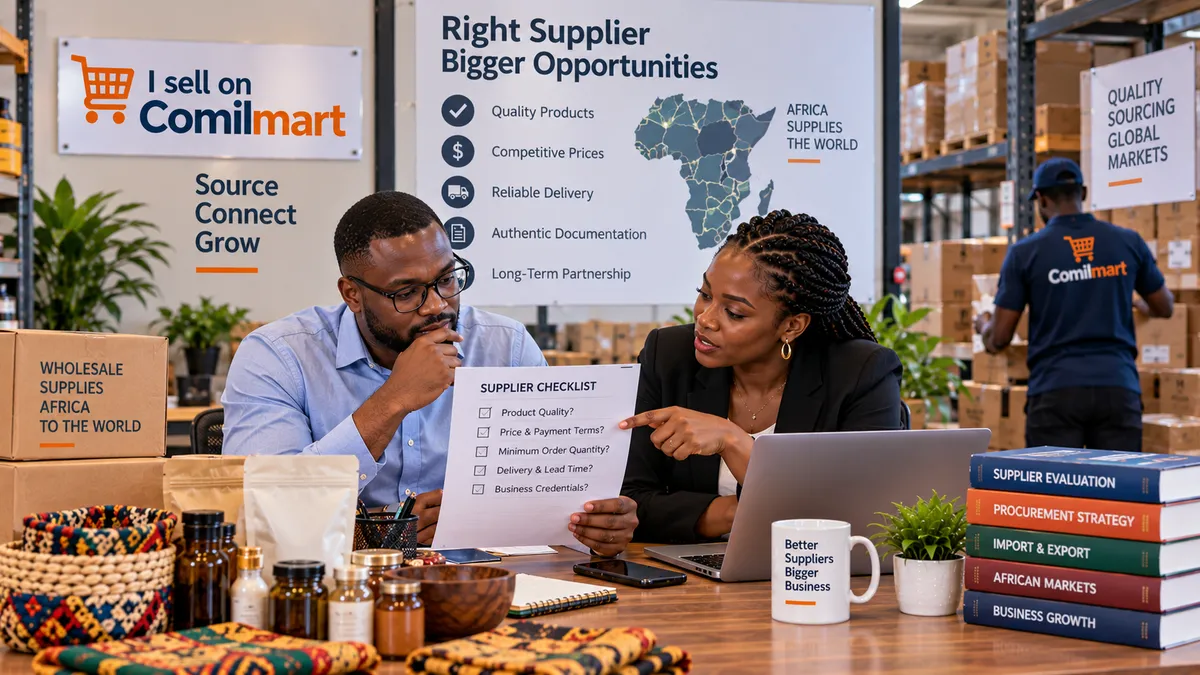
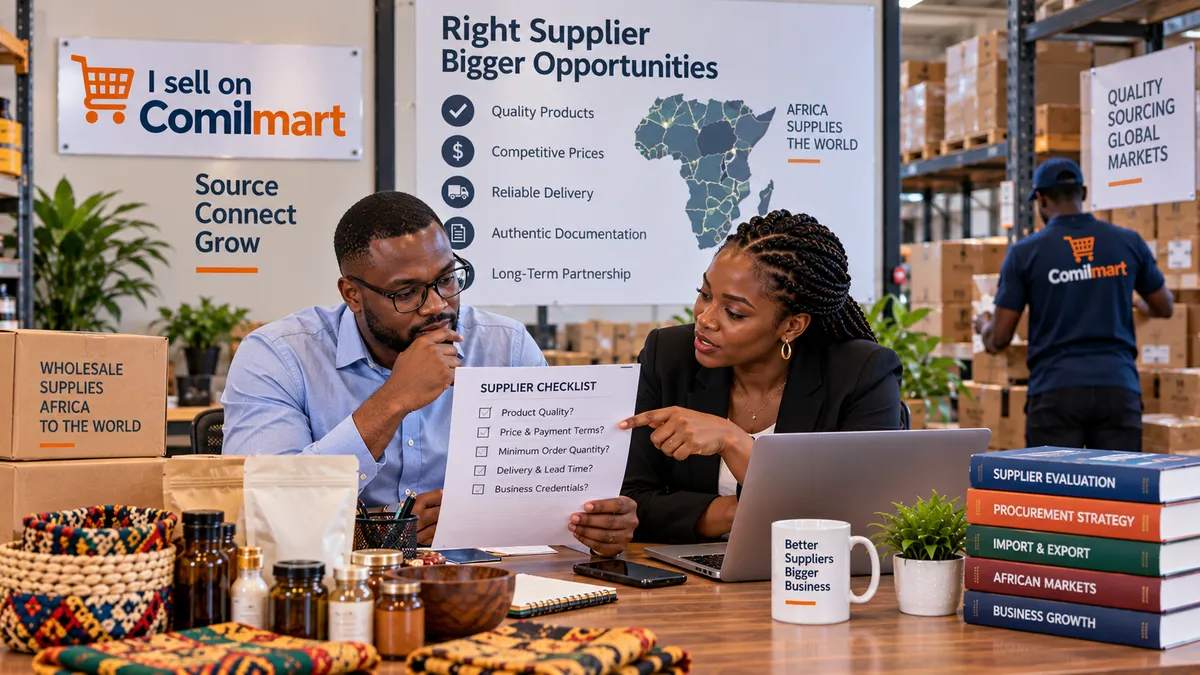
Choosing a wholesale supplier is the start of an ongoing relationship, not a one-off purchase decision made purely on price. A supplier you work well with becomes a genuine business asset over time — consistent quality, predictable lead times, and a communication style you can rely on. A poor fit, discovered only after committing to a large order, can cost far more than the money involved, in wasted time, damaged customer relationships, and the opportunity cost of the better supplier you didn't choose instead. These five questions are worth working through deliberately before you commit, rather than discovering the answers the hard way.
1. What's your realistic lead time — not your best-case one?
Ask specifically about lead time for the quantity you actually need, not their fastest-ever turnaround or a generic estimate that might apply to a much smaller order. There's a meaningful difference between "our fastest possible turnaround under ideal conditions" and "the lead time you should actually plan around for your specific order." A supplier who's upfront about a longer but realistic timeline is generally more trustworthy — and ultimately more useful to actually plan around — than one who promises unrealistic speed just to win your order and then quietly slips the timeline once you've already committed.
A good follow-up question: "Has this lead time held consistently for your recent orders of similar size, or has it been slipping recently?" This gives you a sense of whether the quoted number reflects genuine current capacity or an optimistic aspiration.
2. Can you show me real photos or a sample, not just catalog images?
Stock photography tells you comparatively little about actual product quality — it's often supplied by an original equipment manufacturer or design source, not the specific seller you're evaluating, and may not reflect the actual batch, materials, or quality control standard you'll actually receive. A willingness to share real production photos, or better yet, offer a paid sample, is a genuine signal of confidence in their product and their process.
Pay attention not just to whether they provide this, but how quickly and naturally they do so. A supplier who immediately sends real, specific photos when asked is behaving very differently from one who takes days to respond, sends generic images that don't quite match what you asked for, or simply avoids the question.
3. What happens if something arrives damaged or wrong?
Get clarity on this before you order, not after something has already gone wrong and you're trying to figure out your options under pressure. Ask directly how the supplier has handled quality issues with past orders, and listen for whether their answer describes a genuine, specific process or a vague reassurance that nothing like that has ever happened.
On Comilmart specifically, this question is backed by real buyer protection regardless of what any individual supplier tells you — payment is held until you confirm delivery, giving you structural recourse independent of a supplier's individual policy. But it's still worth understanding a supplier's own stated approach to problems, since a supplier who proactively addresses issues well tends to be a better overall partner than one who's merely compliant with the platform's minimum protections.
4. Is your MOQ flexible for a first order?
Many suppliers have more flexibility on minimum order quantity than their public listing suggests, especially for a first-time buyer they're hoping to build an ongoing relationship with. It's always worth asking directly, framing your request specifically — a particular quantity, and a genuine reason (testing demand, evaluating quality before scaling up) — rather than a vague "can you go lower."
How a supplier responds to this question is itself informative. A supplier who engages seriously with a specific, reasonable request — even if the ultimate answer is no — is showing you a version of the communication style you'd likely experience after placing an order. One who's dismissive or inconsistent is showing you something too, just less encouraging.
5. How do you handle communication once the order is placed?
A supplier who responds quickly and clearly during the sales conversation, when they're actively trying to win your business, but goes quiet after payment is received, is a genuine and fairly common risk pattern. Ask directly: "Once I've placed an order, how will I get updates on production and shipping status?" A specific, concrete answer — regular updates at defined stages, a specific point of contact — is a much better sign than a vague "we'll keep you posted."
If the platform shows a supplier's response rate and average response time, this is often the single clearest, most objective signal available for what to expect after you've paid — it's based on real, measured data from actual buyer interactions, not just what a supplier tells you about themselves during the sales conversation.
How to actually use these five questions in a real conversation
Rather than firing off all five questions in a single message, which can feel like an interrogation and may get a less thoughtful response, it often works better to weave them naturally into your genuine sourcing conversation. Ask about lead time and photos early, since these are foundational to even evaluating whether the product fits your needs. Save the damage/quality-issue question and the communication question for once you're seriously considering the supplier, since these are naturally the kind of questions a buyer asks when they're close to actually committing — which also signals to the supplier that you're a serious prospect worth their genuine attention.
What strong answers across all five actually indicate
A supplier who answers all five questions specifically, consistently, and without evasion is showing you something valuable beyond just the individual answers: a business that's organized enough to actually know these answers, and confident enough in their own operation to share them candidly. This combination — organizational maturity plus transparency — is a genuinely strong predictor of a good ongoing relationship, arguably more predictive than the specific content of any single answer on its own.
What to do if a supplier answers poorly on one or two of these
Not every imperfect answer is disqualifying on its own — a newer supplier might genuinely have a higher MOQ than you'd like without that reflecting poorly on their reliability elsewhere, for instance. Weigh the pattern across all five rather than treating any single weaker answer as an automatic dealbreaker. It's when several of these questions get vague, inconsistent, or evasive answers together that the overall picture becomes a real reason for caution, more than any individual question in isolation.
Frequently asked questions
Should I ask these same five questions even for a small, low-risk order?
For a very small trial order or sample, a lighter version is reasonable — but if you're planning to build toward a larger ongoing relationship, it's worth asking the full set even on an initial smaller order, since you're really evaluating the relationship, not just this one transaction.
What if a supplier gets defensive when I ask these questions?
A reasonable, professional supplier generally understands that a serious buyer asks questions like these as a normal part of due diligence, and doesn't take genuine, respectfully-asked questions personally. Defensiveness in response to fair, specific questions is itself a data point worth weighing.
A bonus question worth asking: "Why should I choose you over a similar supplier?"
This direct, slightly unconventional question often reveals more than any of the five above, precisely because it's less expected. A confident, established supplier usually has a genuine, specific answer — years of experience in a particular niche, a distinctive quality control process, a specific certification competitors lack, or simply an honest acknowledgment of where they excel and where a competitor might actually be a better fit for a particular need. A supplier who responds only with generic claims ("we're the best," "highest quality") without any specific substance behind it is giving you comparatively little to actually evaluate.
How these questions apply differently across product categories
The core five questions apply broadly, but their relative importance shifts depending on what you're sourcing. For products where color or material feel is critical — textiles, cosmetics packaging, printed goods — the photo/sample question carries outsized weight, since these are exactly the attributes hardest to convey any other way. For complex or custom products, the lead-time question becomes especially important, since production timelines for genuinely custom work tend to be less predictable and more prone to slipping than standard catalog items. For any product where you're planning a large, ongoing volume relationship rather than a one-off purchase, the communication-after-payment question becomes the most consequential of all, since you'll be relying on that communication repeatedly over what you hope will be a long relationship, not just once.
Keeping a simple record across multiple supplier conversations
If you're evaluating several potential suppliers for the same product simultaneously, it's genuinely useful to keep a simple written record of how each one answered these questions, rather than relying on memory across multiple parallel conversations. A basic table — supplier name, lead time quoted, photo/sample responsiveness, quality-issue policy, MOQ flexibility, communication commitment — makes the eventual comparison far more objective and less prone to being swayed by whichever conversation happened most recently or left the strongest immediate impression, rather than the one that was actually strongest across all five dimensions.
Frequently asked questions, continued
Is it reasonable to ask these questions before I've even settled on a specific product from this supplier?
Yes — many of these questions, particularly around communication style and quality-issue handling, are really about evaluating the business as a whole rather than one specific product, and are worth asking as you're still deciding whether to seriously consider this supplier for anything at all.
What if I'm buying such a small quantity that a full relationship-building conversation feels excessive?
For genuinely minor purchases, a lighter touch is reasonable. But it's worth remembering that today's small order is sometimes tomorrow's larger one if the relationship goes well — asking even a couple of these questions early can save you from needing to re-evaluate a supplier from scratch later, once you're already more invested in the relationship.
A simple worked comparison
Consider a buyer evaluating two suppliers for the same product category. Supplier A quotes a 3-week lead time, immediately shares real production photos when asked, describes a specific process for handling quality issues (photo documentation, partial refund or replacement depending on severity), offers a modest MOQ reduction for a first order, and commits to weekly status updates once an order is placed. Supplier B quotes "2-3 weeks, maybe faster," sends a stock catalog image when asked for photos, says quality issues are "rare, don't worry about it" without further detail, declines to discuss MOQ flexibility at all, and doesn't directly answer the question about post-order communication.
On price alone, these two suppliers might look identical or Supplier B might even appear marginally cheaper. But the pattern across these five questions paints a meaningfully different picture of what an actual working relationship with each would likely be like — and it's exactly this kind of comparison, built from specific answers rather than a gut feeling alone, that the five-question framework is designed to surface clearly before you've committed any real money to finding out the hard way.
Should I write these five questions down before I message a new supplier?
It's genuinely useful to, especially early on before this becomes second nature — having them ready ensures you don't forget one in the flow of a conversation, and asking them consistently across every supplier you evaluate makes your eventual comparisons fair and complete rather than accidentally uneven.
The bottom line
None of these five questions are about catching a supplier out or being unnecessarily suspicious — they're about setting clear expectations upfront, which is exactly what a good long-term supplier relationship is genuinely built on. A few extra minutes spent asking them, and genuinely paying attention to how they're answered, is one of the highest-leverage things you can do before committing to a new supplier relationship.