
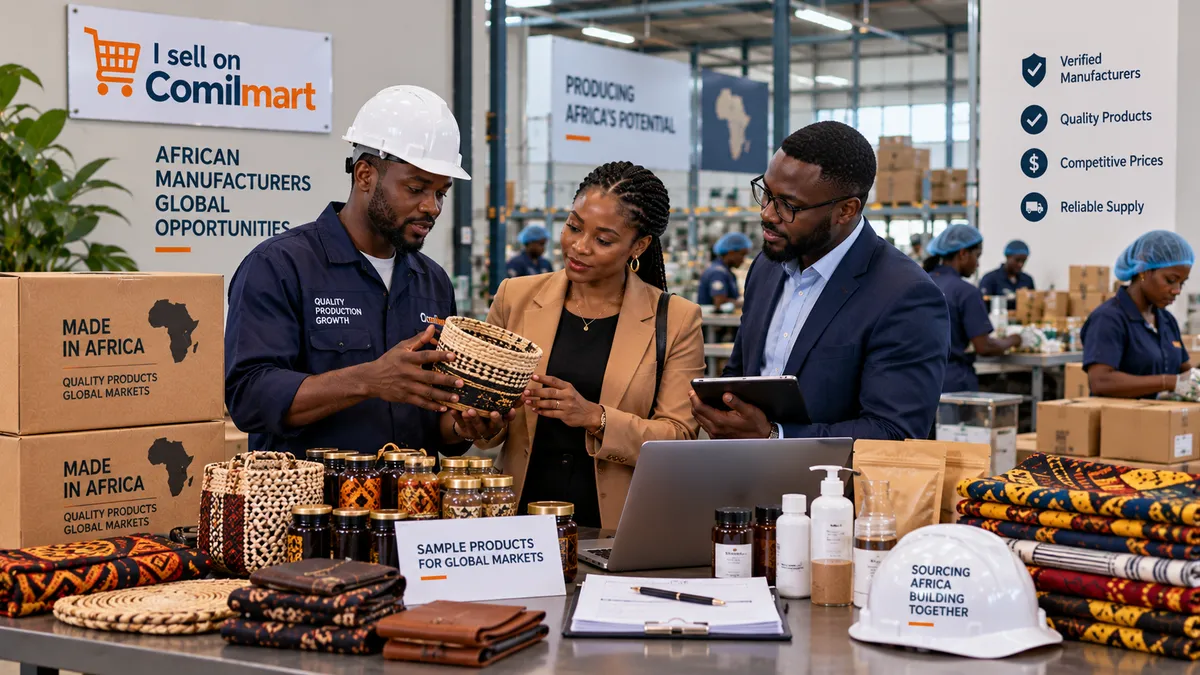
Sourcing & Trade Guide
How to Source Wholesale Products from Verified African Manufacturers
Comilmart Team
August 20, 2026
International buyers are increasingly looking to Africa for competitively priced manufacturing — from textiles and agro products to electronics assembly and industrial components. But sourcing from a region you're less familiar with naturally raises questions: How do you find genuinely reliable manufacturers? What should you expect on pricing and lead times? And how do you protect yourself when the usual local safety nets don't apply the same way across a border? This guide walks through a practical approach to sourcing from African manufacturers with real confidence.
Why African manufacturing has grown as a sourcing option
Several factors have converged to make African manufacturing a genuinely more accessible option for international buyers than it was even a few years ago. Manufacturing capacity has expanded across multiple regions, driven by both domestic investment and international partnerships. Digital infrastructure — payment processing, logistics coordination, verified marketplace platforms — has matured enough to make cross-border transactions meaningfully less risky than they once were. And competitive labor and material costs, combined with growing production quality, have made African-manufactured goods a genuinely attractive alternative to buyers looking to diversify beyond traditional sourcing regions.
Start with verification, not just price
The lowest quote isn't always the best deal if the supplier behind it can't be verified. Look for a marketplace that runs a real Know Your Supplier (KYS) process — checking business registration and documentation before a manufacturer can list — rather than one that lets anyone open a storefront unchecked. Verification is your first and most important filter, because it establishes that you're dealing with a real, accountable business before you evaluate anything else about the specific opportunity.
Beyond platform-level verification, it's worth doing your own quick check too: does the business have a consistent name and details across their profile, their communications, and any documentation they share? Small inconsistencies aren't automatically disqualifying, but worth asking about directly if you notice them.
Understand regional manufacturing strengths
Different African regions have developed genuine, distinct manufacturing and export strengths, and knowing roughly where your product category is strong helps you source from the right region rather than just the first supplier you happen to find:
- West Africa has particular strength in agro-processing — cocoa products, cashew processing, shea butter refinement — alongside a growing textile and garment manufacturing base.
- East Africa has developed strong horticulture and cut-flower export capacity, alongside leather goods manufacturing and a growing textile sector of its own.
- Southern Africa carries genuine strength in mining-adjacent industrial manufacturing, alongside more diversified light manufacturing capacity in several countries.
- North Africa has an established manufacturing base in textiles, automotive components, and increasingly electronics assembly, benefiting from proximity to European markets.
This is a general pattern, not a strict rule — strong manufacturers exist outside these generalizations too, and a marketplace's verification and category data are more reliable for a specific search than regional stereotypes alone.
Ask about lead times honestly, and be specific
Manufacturing and shipping timelines can vary more than buyers expect, and this is one of the areas where clear, direct communication with a supplier matters most. Ask specifically: What's the production lead time for the exact quantity I need, not your fastest example? What's the typical shipping method and transit time to my destination? Has this timeline held consistently for your recent orders, or has it been slipping?
A supplier who gives you a specific, realistic answer — even if it's longer than you'd hoped — is generally more reliable than one who promises unrealistically fast turnaround just to win your order. Treat vague answers ("soon," "not too long") as a signal to ask again more specifically, rather than accepting the vagueness and hoping for the best.
Use a sample order first
Before committing to a full bulk order, ordering a small paid sample lets you evaluate actual product quality, packaging, and how the supplier handles a real transaction — a genuinely low-risk way to build trust before scaling up. This is particularly valuable for a first cross-border relationship, where you haven't yet had the chance to build confidence through repeat transactions.
Where sample ordering isn't formally offered on a listing, it's worth asking the supplier directly whether they'd accommodate a smaller trial order — many manufacturers are more flexible about this for a serious, specific buyer than their public listing suggests.
Understand the payment and logistics landscape
Cross-border payment and shipping to and from African manufacturing hubs has genuinely modernized, but it's worth understanding the practical landscape rather than assuming it works identically to domestic sourcing. Payment processing through a verified marketplace platform, rather than direct bank transfer, protects you in ways that matter more for cross-border transactions specifically — jurisdictional recourse if something goes wrong is often much more limited than it would be for a domestic dispute.
On the shipping side, freight costs and transit times from African manufacturing hubs vary meaningfully by region and destination — get a real quote for your specific route and shipment size rather than assuming a generic estimate applies, and factor this into your true landed cost calculation alongside the unit price itself.
Lean on buyer protection for cross-border peace of mind
Cross-border sourcing means your usual local consumer protections don't automatically apply. A marketplace that holds payment until you confirm delivery gives you real leverage if something goes wrong, regardless of which country your supplier is in — this matters especially for a first-time relationship with an unfamiliar supplier in an unfamiliar region, where you haven't yet built the track record that makes trust easier.
Common misconceptions worth addressing directly
A few assumptions buyers sometimes bring to African sourcing are worth correcting directly. Manufacturing capability varies enormously by country and sector — treating "African manufacturing" as a single, uniform category misses real, significant differences in capacity and specialization across the continent, the same way "Asian manufacturing" would be too broad a generalization to be useful. Similarly, price competitiveness doesn't mean uniformly lower quality — verified, established manufacturers across African regions produce genuinely high-quality goods, and evaluating quality through the same diligence process (verification, samples, reviews) you'd apply anywhere else is the right approach, not assuming quality concerns based on region alone.
Frequently asked questions
Is it harder to verify a manufacturer's legitimacy across an international border?
It can be, if you're trying to verify independently from scratch — which is exactly why a marketplace's own KYS verification process matters more for cross-border sourcing than for a domestic transaction where you might have other ways to check a business's legitimacy.
Should I expect meaningfully different pricing than sourcing from more traditional manufacturing regions?
Pricing varies by product category and specific supplier, similar to any sourcing region — the more useful comparison is landed cost across multiple specific quotes for your actual product, rather than a general assumption about one region being cheaper than another.
What's the biggest mistake first-time buyers make when sourcing from a new region?
Skipping the verification and sample-order steps because a price looks especially attractive. The diligence process matters more, not less, when you're building a relationship with an unfamiliar supplier in an unfamiliar market — the fundamentals in this guide apply with extra weight here, not as an optional extra step.
A closer look at agro-processing, one of the strongest growth categories
Agro-processed goods deserve particular attention as a category, because the shift from exporting raw commodities to exporting processed, finished goods represents one of the more significant recent changes in African manufacturing. Rather than exporting raw cocoa beans, more producers are now exporting cocoa butter, powder, and finished chocolate products. Rather than raw shea nuts, refined and packaged shea butter. This shift matters for buyers because it means sourcing a more finished, higher-value product directly, rather than needing to arrange separate processing yourself after import.
For buyers specifically interested in this category, it's worth asking a supplier directly about their processing capability and any relevant food safety certifications, since agro-processed goods intended for food or cosmetic use typically carry more stringent regulatory requirements at your destination than raw materials would.
Building a long-term relationship versus one-off sourcing
Buyers who source successfully from any new region, African manufacturing included, tend to think in terms of building a small number of genuine ongoing supplier relationships rather than constantly searching for the single lowest price across many one-off transactions. A supplier who knows you as a repeat, reliable buyer is more likely to prioritize your orders, communicate proactively about potential delays, and extend flexibility on things like MOQ or payment terms than one dealing with you for the first and possibly only time.
If you find a manufacturer who performs well on an initial sample or trial order — responsive communication, accurate lead times, quality matching what was promised — it's often worth prioritizing that relationship for future orders even if a marginally cheaper option appears elsewhere, simply because the accumulated trust and reliability has real value that a slightly lower unit price doesn't capture.
Documentation and export requirements worth understanding upfront
Cross-border sourcing, regardless of origin region, involves documentation that's worth understanding before you commit to an order rather than discovering after the fact. Ask your supplier directly about what export documentation they typically provide — commercial invoices, certificates of origin, any product-specific certifications relevant to your destination market. A supplier experienced in exporting internationally will generally be familiar with this and able to speak to it specifically; unfamiliarity or vagueness here is worth noting as you evaluate how experienced they actually are with international shipments, separate from their manufacturing quality itself.
Frequently asked questions
Are there specific product categories where African manufacturing is a particularly strong fit right now?
Agro-processed goods, textiles and apparel, and handcrafted goods currently show particularly strong momentum, alongside growing capacity in health and medical equipment and furniture manufacturing — though strong individual manufacturers exist well beyond these specific categories too.
How do I handle language or communication style differences with a new supplier?
Being specific and direct in your own questions — rather than assuming shared context — tends to smooth over most communication gaps regardless of where a supplier is located. If responses consistently feel unclear despite specific questions, that's worth weighing as you'd weigh any other communication red flag, rather than assuming it's purely a language issue that will resolve itself.
Should I visit a supplier's facility in person before placing a large order?
For very large, ongoing commitments, an in-person visit is genuinely valuable if it's practical for you — but for most orders, the combination of platform verification, requested photos/video, and a sample order provides a reasonable level of confidence without needing to travel, especially for a first order building toward a larger future relationship.
A practical first-order checklist
- Confirm the supplier carries real platform verification, not just a self-reported claim
- Ask for real photos or video of their actual production facility
- Get a specific, honest lead time for your actual order quantity
- Order a sample first if one is available, or ask directly about a smaller trial order
- Confirm which export documentation they typically provide
- Get a real freight quote for your specific shipment rather than assuming a generic rate
- Keep payment on-platform to preserve buyer protection throughout the transaction
Working through this list before committing to a full order takes relatively little time, and it's the same disciplined approach that serves buyers well regardless of which region they're sourcing from.
A note on the wider trend
The growth in African manufacturing sourcing isn't a passing trend driven by a temporary price advantage — it reflects genuine, sustained investment in production capacity, logistics infrastructure, and verified digital marketplaces across the continent. Buyers who build real sourcing relationships now, applying the same diligence they'd apply anywhere else, are positioning themselves well for what's likely to be a continued expansion of manufacturing capability and export sophistication in the years ahead, rather than treating this as a short-term opportunity to chase before it changes.
The bottom line
African manufacturing offers real, growing opportunities for international buyers — competitive pricing, expanding capacity, and increasingly accessible verified suppliers. Approaching it with the same rigor you'd apply to any new sourcing relationship — verification first, honest lead-time conversations, a sample order before scaling up, and genuine buyer protection backing the transaction — turns "sourcing from an unfamiliar region" into simply "sourcing well," regardless of where the supplier is located.