
Sourcing & Trade Guide
A Buyer's Guide to MOQ and Price Tiers
Comilmart Team
August 20, 2026
If you're new to wholesale buying, seeing a listing with "MOQ: 500 units" and a table of prices that changes by quantity can be confusing. Why does the price drop as you buy more? Is the MOQ actually fixed? And how do you figure out the right quantity for your specific situation, rather than either over-ordering to chase a better price or under-ordering and missing out on real savings? This guide breaks down exactly what's going on with MOQ and tiered pricing, and how to use both to your genuine advantage.
What MOQ actually means
Minimum Order Quantity is the smallest amount a supplier will sell in one order. It exists because manufacturing setup — running a production line, sourcing raw materials, running quality control — has fixed costs that only make sense at a certain volume. A supplier isn't trying to shut smaller buyers out for its own sake; they're covering the real cost of producing at all. Below a certain order size, the fixed costs of production simply can't be recovered by the sale price, and the order stops making financial sense for them to accept.
Why price drops as quantity goes up
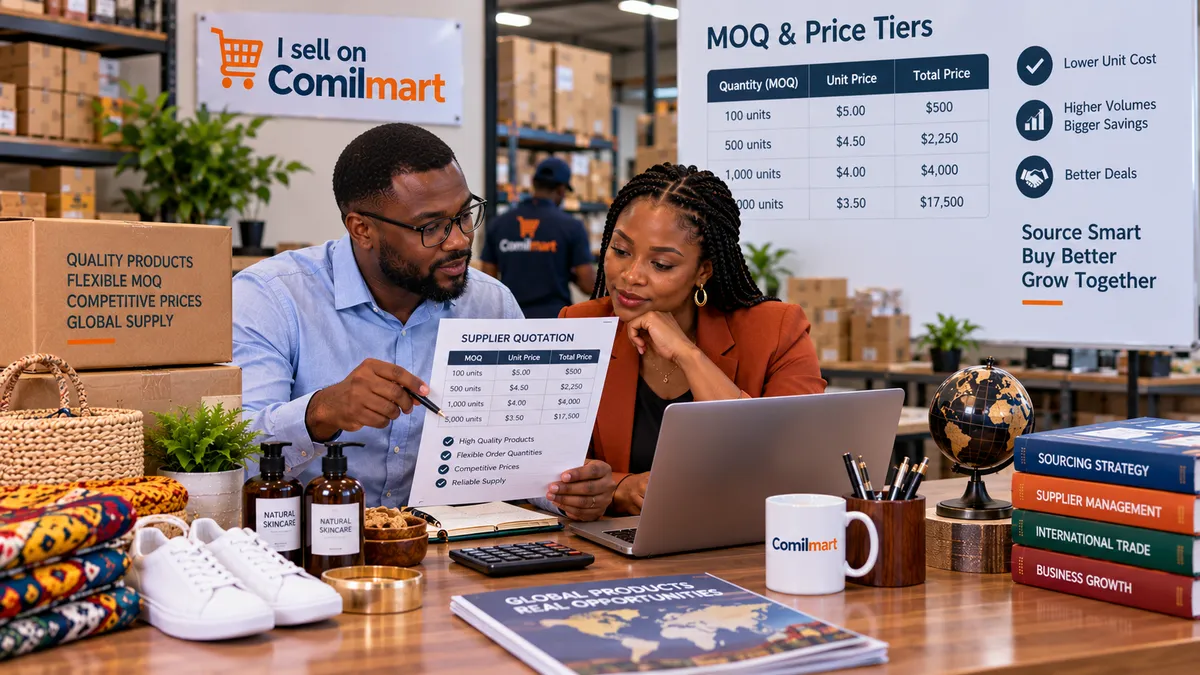
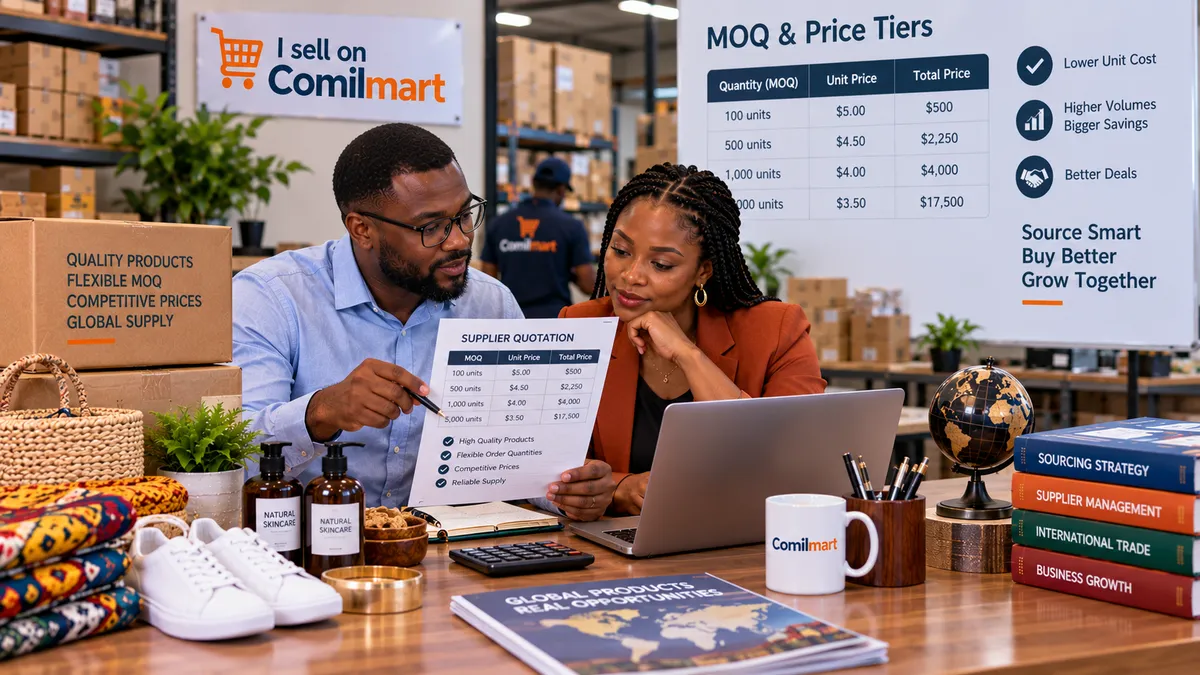
Price tiers reflect the same underlying logic in reverse: the more you order, the more the fixed setup costs get spread across each individual unit, so the per-unit price drops. A tier table showing $5.00 per unit at 100 units, $4.20 per unit at 500 units, and $3.50 per unit at 1,000-plus units is simply showing you that math directly — the fixed cost of running the production line is the same regardless of order size, but it represents a smaller share of each unit's cost as the total order grows.
Understanding this mechanism matters because it changes how you think about "getting a better deal." The lower price at higher tiers isn't a discount a supplier is granting you as a favor — it's a direct reflection of reduced per-unit fixed-cost burden. This means the tiers themselves are usually a fairly accurate, non-arbitrary representation of the supplier's actual cost structure, which is useful context when you're deciding where on the table to land, or whether to negotiate.
How to read a price tier table properly
A typical tier table lists a series of quantity breakpoints, each with an associated per-unit price. It's worth reading these carefully rather than just glancing at the lowest number on the table:
- Confirm whether tiers are "at least this quantity" or "exactly this range." Most listings use "at least" breakpoints — ordering 600 units when the tier starts at 500 gets you the 500-tier price — but it's worth confirming this explicitly rather than assuming, especially for an unfamiliar supplier.
- Check whether the tier price includes or excludes shipping. Some listings quote pure product price per tier; others build in an estimated shipping cost. Confirm which you're looking at before comparing across suppliers.
- Notice where the price curve flattens. Often, the price difference between a mid-tier and the highest tier is much smaller than the difference between the lowest tier and the mid-tier — meaning there's frequently a point beyond which ordering significantly more doesn't meaningfully improve your per-unit price. Identifying that point helps you avoid over-ordering purely to chase a marginal additional discount.
How to decide where to land on the tier
Don't just chase the lowest per-unit price — buying more than you can actually sell or use ties up cash and storage space, and that cost rarely shows up in the same place as the per-unit price comparison, which makes it easy to overlook. Work backward from your real demand: how much can you realistically move or use in a reasonable timeframe? That's your target quantity, and the tier price at that quantity is your real, relevant cost — not the headline lowest price on the table that requires an order size well beyond what you actually need.
A useful exercise: calculate the total cost at your actual planned quantity, then calculate the total cost at the next tier up. If moving to the next tier meaningfully lowers your per-unit price and you have genuine confidence you can use or sell the additional quantity within a reasonable window, it may be worth the larger commitment. If the savings are marginal, or you're not confident you can move the additional volume, staying at your originally planned quantity is usually the more sound decision, even if it means missing the "better" headline price.
If the MOQ is too high for you
You have a few genuine options, roughly in order of what tends to work best:
- Negotiate directly with the supplier. Many suppliers have more flexibility than their listed MOQ suggests, especially for a first order from a buyer who communicates a clear, specific need rather than a vague request for a lower minimum.
- Look for a similar product with a naturally lower MOQ from a different supplier — MOQ varies significantly even for very similar products, depending on the specific manufacturer's production setup and business model.
- Consider ordering a small paid sample first if one's available, both to evaluate the product and to build the relationship before asking about a smaller-than-standard trial order.
- Split an order with another buyer who needs the same or a similar product, effectively combining two smaller needs into one order that meets the supplier's minimum.
How tiered pricing interacts with negotiation
It's worth understanding that a published tier table isn't always the final word on pricing, particularly for orders that fall meaningfully above the highest listed tier, or for a buyer building toward an ongoing relationship rather than a single one-off purchase. If your planned order significantly exceeds the top tier on the table, it's reasonable to ask directly whether further pricing improvement is available beyond what's published — suppliers often reserve their best pricing for direct conversation with a serious, high-volume buyer rather than publishing it openly for everyone to see.
A practical example
Consider a buyer who needs approximately 350 units of a product with the following published tiers: 100 units at $6.00, 500 units at $4.80, and 1,000 units at $4.20. Ordering exactly 350 units at the closest applicable tier (likely the 100-unit tier, since 350 doesn't reach the 500-unit breakpoint) means paying $6.00 per unit, for a total of $2,100. Bumping the order up to 500 units to reach the next tier brings the per-unit price down to $4.80, for a total of $2,400 — spending $300 more to receive 150 additional units, meaning those extra units effectively cost $2.00 each.
Whether that's a good deal depends entirely on whether the buyer can genuinely use or sell those additional 150 units within a reasonable timeframe. If yes, moving to the 500-unit tier is a clear win. If the buyer only actually needs 350 units and has no real path to using the extra 150, the "cheaper" per-unit price at the higher tier isn't actually cheaper in any way that matters — it's just tying up more cash for inventory that may sit unused.
Frequently asked questions
Do MOQ and tier pricing apply the same way to every product category?
The underlying logic applies broadly, but the specific numbers vary enormously by product complexity — a simple, low-tooling product might have an MOQ of a few dozen units with a gentle price curve, while a highly custom or complex product might have an MOQ in the thousands with a much steeper curve between tiers.
Is it ever worth ordering below the lowest published tier?
Sometimes — some suppliers accommodate smaller trial orders at a premium price outside their published tier structure entirely, functioning similarly to a formal sample order. It's always worth asking directly if this fits your situation.
Should I always negotiate, or is that considered inappropriate?
A specific, reasonable negotiation request is completely normal in wholesale buying and shouldn't be seen as inappropriate — suppliers expect it, particularly for orders near or above their published tier structure. The key is being specific and reasonable rather than making a vague, open-ended request to "do better."
MOQ and tiered pricing for custom or branded products
Everything covered so far applies most directly to off-the-shelf products a supplier already manufactures at scale for many buyers. Custom or private-label products — your own branding, unique specifications, custom packaging — work somewhat differently and deserve a specific note. Custom orders typically carry meaningfully higher MOQs than the same supplier's standard catalog items, because the setup cost for a custom production run (new molds, custom packaging materials, dedicated quality control for your specific requirements) is a genuinely separate fixed cost from their standard production, on top of the usual per-unit costs already factored into their regular tier pricing.
If you're pursuing a custom product for the first time, it's worth asking directly whether the supplier has a lower-commitment path to test your specific customization — sometimes a supplier will accommodate a smaller custom trial run at a premium price, similar in spirit to a standard sample order, before committing to their full custom MOQ.
How seasonal and demand fluctuations affect MOQ and pricing
MOQ and tier pricing aren't always static year-round for every supplier. Some manufacturers, particularly in categories with genuine seasonal demand, adjust their minimums and pricing based on their current production schedule — a supplier heading into their busiest season may raise MOQs or reduce flexibility simply because their production capacity is already committed to other orders, while the same supplier during a slower period might offer more favorable terms to fill otherwise idle capacity. If timing isn't urgent for your order, it's worth asking a supplier directly whether ordering during a different part of their production cycle might offer better terms.
Comparing tier pricing across multiple suppliers properly
When comparing tier pricing from different suppliers for a similar product, it's important to compare at the same quantity point, not just glance at each supplier's lowest published tier. A supplier whose lowest tier requires 2,000 units isn't necessarily cheaper than one whose lowest tier is 200 units, if you only actually need 300 units — in that case, the second supplier's price at your actual planned quantity is the only genuinely comparable number. Building a simple table yourself, with each candidate supplier's price at your specific target quantity, avoids the common mistake of comparing headline "best price" figures that don't actually apply to your real order size.
Frequently asked questions, continued
What happens if my needs grow over time — do I need to renegotiate every time?
Many suppliers are willing to set an ongoing pricing arrangement for a repeat buyer, particularly once you've established a track record together, rather than renegotiating tier-by-tier on every individual order. It's worth raising this directly once you've placed a couple of successful orders with a supplier you intend to keep working with.
Can price tiers change after I've already started a relationship with a supplier?
Yes, particularly over longer periods as raw material costs or the supplier's own production costs shift. This is normal and not usually a sign of anything concerning on its own — but a sudden, unexplained, significant price change is worth a direct conversation to understand the reason behind it.
A quick mental checklist before you order
- Have I confirmed whether tiers are "at least" or fixed ranges?
- Does the tier price include or exclude shipping?
- Where does the price curve start to flatten, and is chasing a higher tier actually worth it for my real needs?
- Can I genuinely use or sell any additional units I'd be ordering to reach a better tier?
- If my planned order exceeds the top published tier, have I asked directly about further pricing?
Running through these before finalizing a wholesale order takes only a couple of minutes, but it's the difference between a genuinely informed purchasing decision and simply picking whichever number on the table looks the most impressive at a glance.
The bottom line
MOQ and tiered pricing aren't obstacles designed to frustrate smaller buyers — they're a fairly direct reflection of how production costs actually work. Understanding the logic behind them, reading the tier table carefully, and working backward from your genuine demand rather than chasing the lowest headline number helps you negotiate and plan with real confidence, and avoid the common trap of over-ordering just because the per-unit math looked slightly better on paper.