
Sourcing & Trade Guide
Sourcing from Ghana: A Buyer's Guide to West Africa's Growing Manufacturing Hub
Comilmart Team
August 22, 2026
Ghana has built a genuine reputation as one of West Africa's more stable, business-friendly manufacturing and export destinations, drawing growing interest from international buyers looking to diversify their sourcing beyond more traditional manufacturing hubs. This guide covers what makes Ghana a genuinely attractive sourcing option, what to expect, and how to approach your first order well.
Why Ghana has become an attractive sourcing destination
Several factors have contributed to Ghana's growing reputation among international buyers. Political and economic stability, relative to some regional neighbors, has made it an easier environment for both local manufacturers to invest in growing their capacity and international buyers to feel confident building longer-term sourcing relationships. Ghana's cocoa processing industry in particular has developed real depth and sophistication, moving well beyond raw bean export into cocoa butter, powder, and finished chocolate products. English as an official language also removes a communication barrier that exists when sourcing from some other regions, simplifying contract negotiation and day-to-day communication.
Ghana's strongest export categories
While Ghana produces across many categories, a few areas show particular strength worth knowing about specifically:
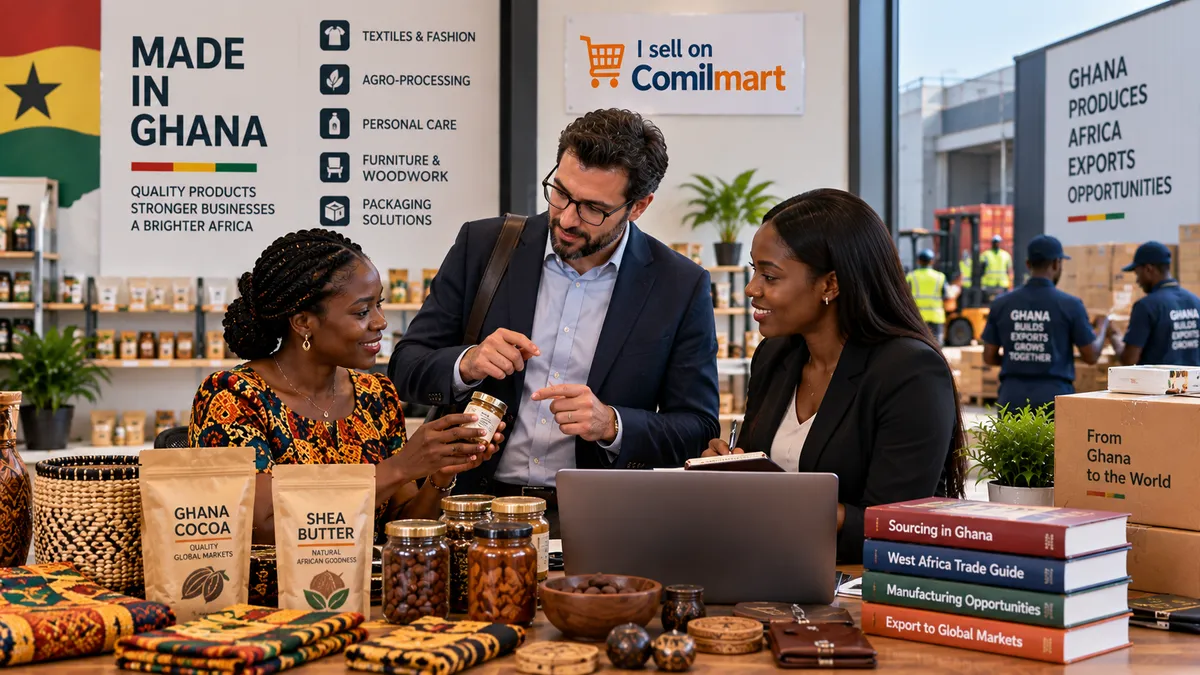
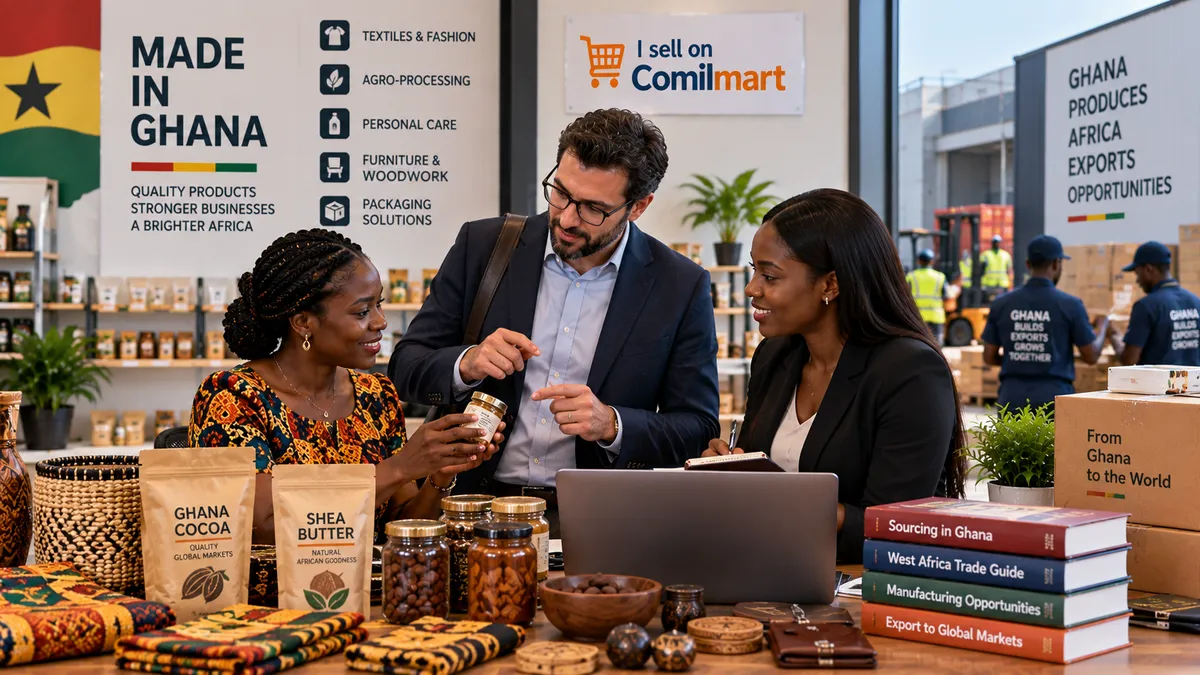
- Cocoa and cocoa-derived products — Ghana is one of the world's leading cocoa producers, and increasingly, a genuine processor rather than purely a raw material exporter, offering cocoa butter, powder, and finished chocolate products directly.
- Shea butter and shea-derived cosmetics ingredients — a genuinely strong category, with both raw and refined shea products available from producers with real export experience.
- Textiles — including traditional Kente cloth alongside more conventional textile manufacturing, offering both distinctive craft products and standard textile production capacity.
- Gold and other minerals — though this category involves its own specific regulatory and logistics considerations distinct from consumer goods sourcing.
- Agricultural products beyond cocoa — including cashews, which have grown as a genuine export category alongside cocoa.
What to expect from Ghanaian manufacturers and exporters
Buyers working with established Ghanaian exporters, particularly in the cocoa and shea processing sectors, generally find a reasonably professional export infrastructure — many producers in these categories have real experience with international documentation, quality certification, and export logistics, since these are long-established export categories for the country. For newer or smaller-scale manufacturers in less established export categories, the same diligence that applies to any new supplier relationship — verification, sample ordering, clear communication about lead times — remains just as important as it would sourcing from anywhere else.
Logistics and shipping from Ghana
Ghana's port infrastructure, particularly the Tema and Takoradi ports, provides reasonably well-established shipping access to major international destinations, and freight forwarders with genuine experience handling Ghanaian export shipments are readily available. As with sourcing from any country, getting a specific freight quote for your particular shipment size and destination — rather than assuming a generic rate — gives you the accurate landed cost picture you need for a real purchasing decision.
Understanding Ghana's export documentation requirements
Similar to other West African exporting nations, Ghanaian exports typically require a commercial invoice, packing list, and certificate of origin, with additional certifications required for specific product categories — food safety certification for agricultural and processed food products, for instance. Ghana Export Promotion Authority (GEPA) provides support and registration for exporters, similar in spirit to Nigeria's NEPC, and working with an experienced Ghanaian exporter or freight forwarder who's already navigated this process smooths out much of the complexity for a buyer.
Quality and certification considerations by category
For cocoa and shea products specifically, buyers should expect and can reasonably request relevant quality certifications — organic certification is increasingly available for shea products specifically, given genuine international demand in the cosmetics and food industries for certified organic shea butter. For textile products, understanding whether you're sourcing traditional handcraft production (which carries its own timeline and scale expectations, similar to any artisan-produced goods) versus more standardized manufactured textiles matters for setting realistic expectations about consistency and lead time.
Ghanaian manufacturers interested in reaching international buyers can register as a verified supplier on Comilmart to get started.
Building a first relationship with a Ghanaian supplier
The same fundamentals that apply to evaluating any new supplier apply directly here: verify the business is genuinely registered and, where relevant, GEPA-registered as an exporter; ask for real production photos or video rather than relying solely on catalog images; consider a sample order before committing to a full wholesale quantity, especially for a first relationship; and get specific, honest answers about lead time for your actual order quantity, not a generic best-case estimate.
Communication style is also worth paying attention to as a genuine signal — a supplier who responds specifically and promptly to your questions during the sales conversation is showing you what to expect after you've placed an order, exactly as it would with a supplier from any other region.
A note on regional context
Ghana sits within the broader West African and ECOWAS trade context, meaning cross-border considerations relevant to the wider region — including AfCFTA's progressive implementation and ECOWAS's own trade framework — apply to Ghana specifically as well. If you're evaluating Ghana alongside other West African sourcing options, understanding this regional trade context alongside country-specific factors gives you the fuller picture.
Frequently asked questions
Is Ghana a good option for a buyer newer to African sourcing generally?
Ghana's relative political stability, English-language business environment, and well-established export categories (particularly cocoa and shea) make it a reasonable starting point for buyers newer to African sourcing, though the same diligence fundamentals apply here as with any new sourcing region.
What's the typical MOQ for cocoa or shea products from Ghanaian suppliers?
This varies significantly by specific supplier and their production scale, from smaller cooperatives with more modest minimums to larger processors set up for substantial export volumes — worth checking directly with specific suppliers rather than assuming a single standard figure applies across the whole category.
How does Ghana compare to Nigeria for sourcing, given they're both major West African economies?
Both offer genuine, distinct strengths rather than one being uniformly "better" — Ghana's particular depth in cocoa and shea processing and its relative ease of doing business are notable strengths, while Nigeria offers a much larger overall economy and manufacturing base across a wider range of categories. The right choice depends on your specific product category and sourcing needs rather than a general country preference.
The bottom line
Ghana offers a genuinely attractive combination for international buyers — relative stability, strong depth in specific export categories like cocoa and shea, and a reasonably accessible business environment for a first African sourcing relationship. As with any sourcing decision, the fundamentals of verification, sample ordering, and clear communication remain the foundation of a good outcome, regardless of how favorable the country-level environment is.