
Sourcing & Trade Guide
B2B vs B2C E-commerce: Understanding the Difference
Comilmart Team
August 22, 2026
"E-commerce" gets used as a single, broad term, but business-to-business (B2B) and business-to-consumer (B2C) commerce operate on genuinely different logic — different buyers, different decision processes, different pricing structures, and different expectations around everything from minimum order size to customer service. Understanding these differences matters whether you're a buyer trying to figure out which approach fits your need, or a seller deciding how to structure your business. This guide breaks down what actually distinguishes the two.
Who's actually buying: the core distinction
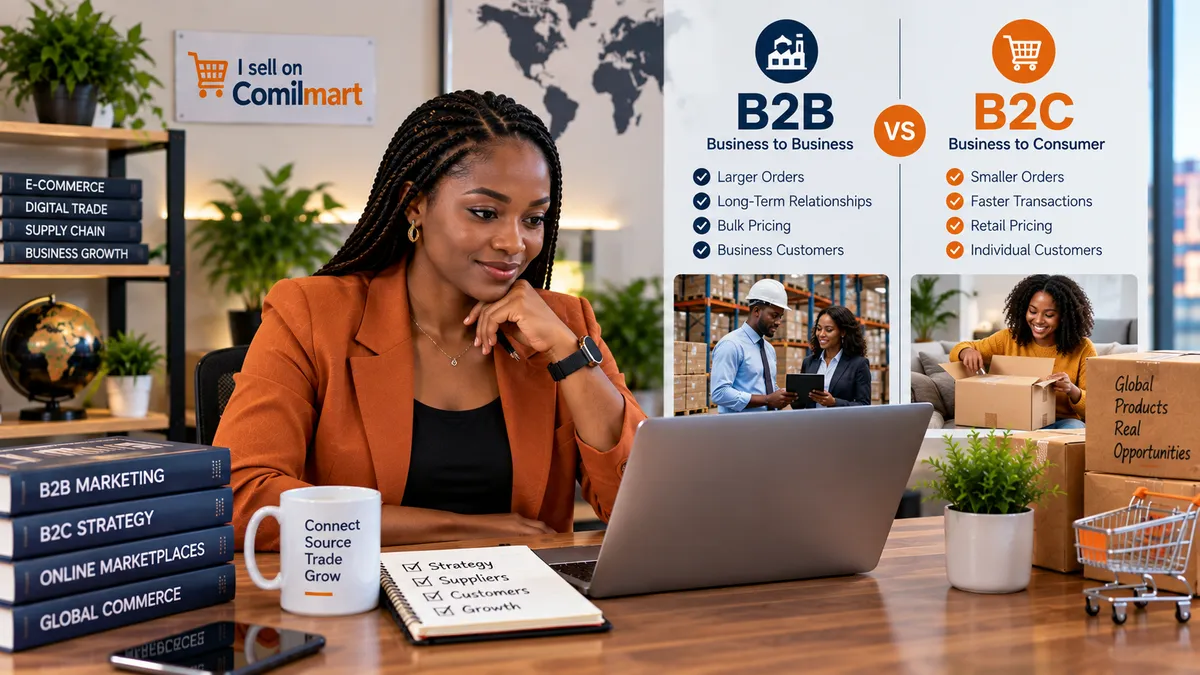
The most fundamental difference is simply who the buyer is and why they're buying. In B2C, the buyer is an individual purchasing for personal use, making a decision based largely on personal preference, immediate need, and individual budget. In B2B, the buyer is a business or professional purchasing for business purposes — to resell, to use in their own production, or to support their own operations — making a decision that typically involves more stakeholders, more formal evaluation criteria, and a longer-term view of the relationship, not just a single transaction.
How purchase decisions actually differ
A B2C purchase decision is often relatively quick, driven substantially by price, immediate appeal, and personal need, frequently made by a single individual without extensive internal deliberation. A B2B purchase decision typically involves more people — a buyer might need approval from a manager or procurement team, and the decision often weighs total cost of ownership, reliability, and the value of an ongoing supplier relationship, not just the immediate transaction price. This is why B2B sales cycles are often genuinely longer, involving more back-and-forth (requesting quotes, negotiating terms) before a purchase actually happens.
Order size and pricing structure
B2C transactions are typically single-unit or small-quantity purchases at a fixed, published retail price. B2B transactions frequently involve minimum order quantities, tiered pricing that decreases as volume increases, and often direct negotiation rather than a fixed, non-negotiable price — reflecting the different cost structure of B2B relationships, where a supplier's fixed production and relationship-management costs get spread across a larger order, or where genuine ongoing relationships justify more flexible, negotiated pricing.
Relationship duration and expectations
A B2C purchase is often, though not always, a relatively transactional, one-off interaction — a consumer buys a product and the relationship, beyond potential future purchases, largely ends there. B2B relationships are frequently structured around an ongoing, repeat relationship from the outset — a business buyer evaluating a new supplier is often thinking about a multi-order relationship, not just a single purchase, which is why factors like consistent quality, reliable communication, and a supplier's genuine capacity to fulfill repeat orders matter more heavily in B2B evaluation than they typically do for a single consumer purchase.
Marketing and discovery differ meaningfully too
B2C marketing tends to emphasize emotional appeal, immediate benefit, and broad reach — consumer advertising, social media presence, and appealing product presentation matter significantly in how B2C buyers discover and evaluate products. B2B marketing tends to emphasize credibility, track record, and specific capability — case studies, certifications, production capacity details, and direct sales conversation matter more heavily than broad emotional appeal, reflecting the more deliberate, multi-stakeholder nature of B2B purchase decisions.
Payment terms and processes
B2C payments are typically immediate, at the point of purchase, using standard consumer payment methods. B2B payments more frequently involve extended terms — net-30 or similar arrangements where payment is due some period after delivery rather than immediately — reflecting the more established, ongoing trust relationships B2B commerce is often built around, alongside the larger transaction sizes that can make immediate full payment more of a cash-flow consideration for the buying business.
What this means if you're deciding which model fits your business
If you're a seller trying to decide whether B2B or B2C better fits your product and business, a few questions help clarify this. Does your product naturally serve individual end-consumer use, or is it more naturally an input or resale item for another business? Can you realistically support the more relationship-intensive, negotiation-heavy sales process B2B typically involves, or does your business model favor higher-volume, more transactional sales that B2C's typically simpler purchase process supports better? And does your genuine cost structure support the kind of tiered, volume-based pricing B2B buyers expect, or does a simpler fixed retail price better reflect how you actually produce and price your product?
Many businesses genuinely operate in both models simultaneously — selling wholesale to business buyers while also maintaining a retail presence for individual consumers — recognizing that these are two genuinely different sales motions requiring somewhat different approaches, even for the same underlying product.
What this means if you're a buyer deciding how to source
Whichever side of this you're on, registering on Comilmart gives you access to both wholesale B2B pricing and retail-friendly listings, depending on what your business needs.
If you're buying for genuine business purposes — reselling, using as a business input, or supplying your own operations — sourcing through B2B channels typically gives you access to better per-unit pricing at the volumes your business actually needs, even though it involves a more involved purchasing process. If you're buying for personal use or in small quantities, B2C generally offers a simpler, faster purchase process better suited to that kind of need, even at a higher per-unit price than bulk B2B pricing would offer.
Frequently asked questions
Can the same product be sold through both B2B and B2C channels?
Yes, and this is genuinely common — many products make sense sold in bulk to business buyers at wholesale pricing and also sold individually to consumers at retail pricing, effectively serving two different buyer types with the same underlying product through different sales structures.
Is B2B commerce inherently more profitable than B2C, or vice versa?
Neither is inherently more profitable — profitability depends on your specific cost structure, the volume you can achieve, and how well your business model matches your target buyer's actual needs, rather than one model being universally superior to the other.
Which model typically has a longer sales cycle?
B2B, generally — the multi-stakeholder decision process, negotiation, and evaluation typical of business purchasing decisions usually takes meaningfully longer than the relatively quick decision process typical of individual consumer purchases.
The bottom line
B2B and B2C commerce aren't just the same activity at different scales — they involve genuinely different buyer psychology, decision processes, pricing structures, and relationship expectations. Understanding which model actually fits your specific product, business capability, and target buyer — rather than assuming one approach universally applies — is foundational to building a sourcing or selling strategy that genuinely works.